


Page 196 - 一千字說華語中英文版
P. 196
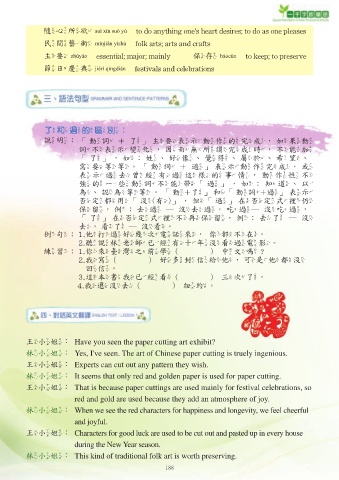
隨心所欲 su0 x9n su# y*     to do anything one's heart desires; to do as one pleases

                  民間藝術 m0nji1n y=sh*     folk arts; arts and crafts
                  主要 zh&y4o     essential; major; mainly        保存 b3oc/n     to keep; to preserve

                  節日慶典 ji6r= q=ngdi3n     festivals and celebrations


                  了和過的區別:
                  說明: 「 動詞  +  了」主要表示動作的完成,如果動
                              詞不表示變化,因而無所謂完成時,不能加
                              「了」,如:姓、好像、覺得、屬於、希望、
                              需要等等。「動詞  +  過」表示動作完成,或
                              表示過去 曾 經有過這樣的事情,動作性 不
                              強的一些動詞不能帶「過」,如:知道、以
                              為、認為等等 。「動+了」 和「動詞+過」表示
                              否定都用「沒(有)」,但「過」在否定式裡仍
                              保留,例:去過  ─沒去過,吃過─沒吃過,
                              「了」在否定式裡不再保留,例:去了  ─沒
                              去,看了 ─沒看。
                  例句: 1.他打過好幾次電話來,你都不在。
                       2.聽說林老師已經有十年沒看過電影。
                  練習:1.你來臺灣之前學(  )中文嗎?
                       2.我寫(  )好多封信給他,可是他都沒
                                回信。
                       3.這本書我已經看(  )三次了。
                       4.我還沒去(  )紐約。


            王小姐:Have you seen the paper cutting art exhibit?

            林小姐:Yes, I've seen. The art of Chinese paper cutting is truely ingenious.
            王小姐:Experts can cut out any pattern they wish.
            林小姐:It seems that only red and golden paper is used for paper cutting.

            王小姐:That is because paper cuttings are used mainly for festival celebrations, so

                                    red and gold are used because they add an atmosphere of joy.
            林小姐:When we see the red characters for happiness and longevity, we feel cheerful
                                    and joyful.

            王小姐:Characters for good luck are used to be cut out and pasted up in every house

                                    during the New Year season.
            林小姐:This kind of traditional folk art is worth preserving.

                                                             188

